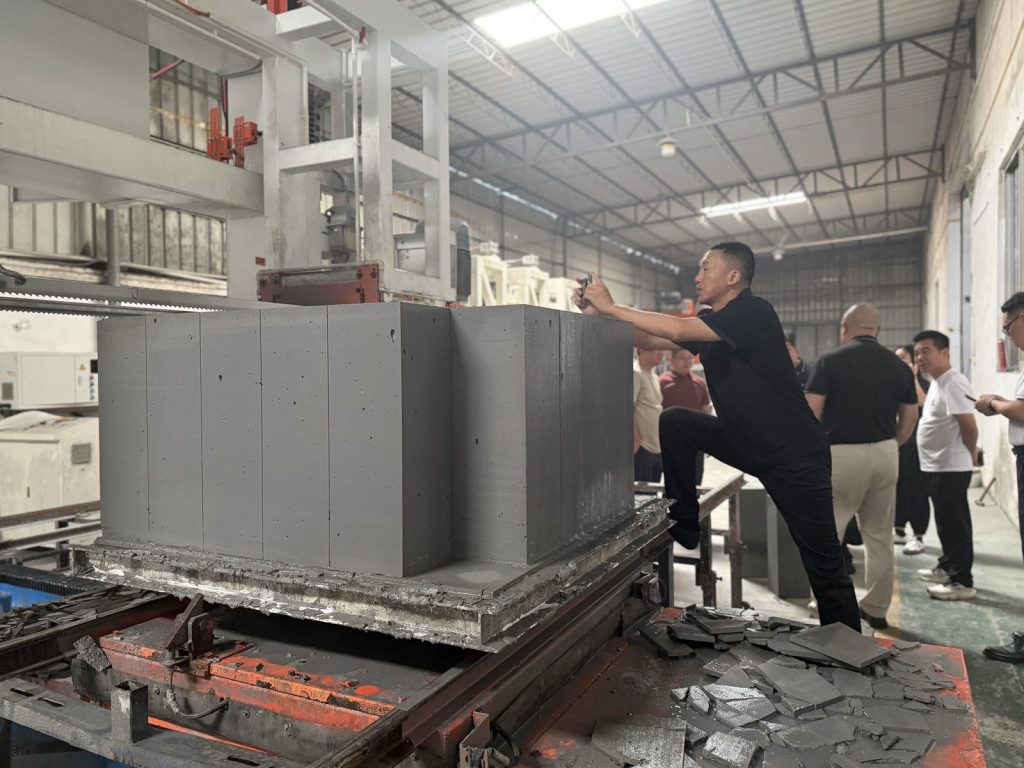
On 3 August 2026, a Malaysian project team visited the equipment factory documented in the source record with a practical list of questions. They were not looking for a quick equipment tour. They wanted to understand whether a CLC block production line could be planned around local materials, a realistic labour team and the product quality expected in their market.
That changed the tone of the visit. The conversation began in the meeting room, but the useful decisions were made by connecting the proposal to what the customer could see on the factory floor.
Starting with the project, not a machine list
The first discussion covered the intended lightweight wall-material product, local raw-material options, output planning, automation level and the support required after delivery. These questions are closely connected. A higher nameplate capacity is not useful if mould circulation, curing space, cutting or material handling cannot keep pace.
The customer also asked how many operators a practical line needs and which tasks should remain manual during the first stage of the project. The engineering team explained that the answer depends on the chosen product, factory layout, shift plan and expansion strategy. The purpose of the initial review was therefore to define the production rhythm before fixing the equipment list.
Buyers planning a similar project can review the documented project record’s overview of complete lightweight block production lines and the factors behind practical production capacity.
What the team checked inside the factory
After the project meeting, the team inspected equipment for batching, pouring, conveying and cutting. Seeing the machines in their working positions made it easier to discuss access for operators, maintenance space and the way one process hands the material to the next.
The customer paid particular attention to cutting. This was reasonable: block geometry affects pallet appearance, masonry speed and mortar consumption long after the equipment has left the factory. The team inspected a freshly cut block body and discussed how billet condition, wire setting, machine rigidity and handling all influence the finished result.
The engineering team does not treat the cutting machine as an isolated purchase. The cutting system has to match the material recipe, initial-setting window, block dimensions and upstream mould cycle.
The visit produced a better next-step list
No factory visit by itself proves that a new project is ready to build. What it can do is replace broad assumptions with a clear list of information that still needs to be confirmed.
For this Malaysian project, the next review will focus on local raw-material samples, the proposed site, target block specifications, planned output and installation conditions. With those inputs, the line layout and equipment scope can be refined around the actual project rather than a generic quotation.
If you are evaluating a Malaysia CLC block production line, send the target product, local materials, planned daily output and available factory dimensions through the project review form. The project team can then start with the questions that affect the whole factory.