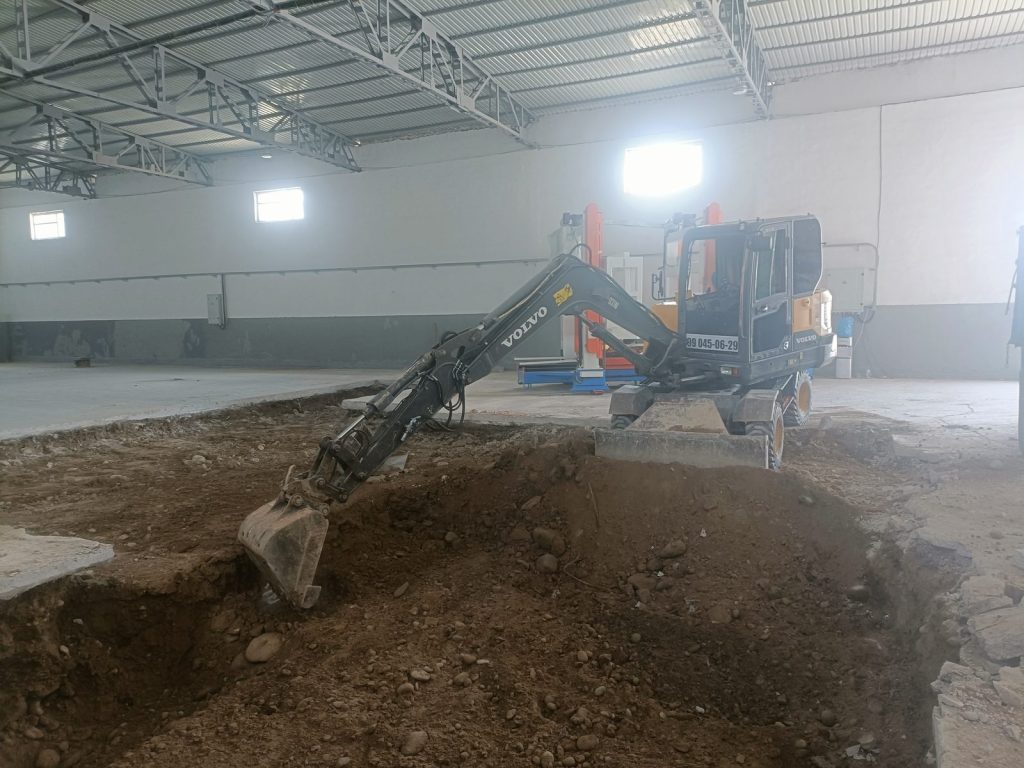
The documented Uzbekistan CLC block line has moved from equipment delivery to on-site installation. The current work covers factory preparation, foundations, track alignment and the staged positioning of the main equipment.
This is the point where a production-line drawing meets the real building. Floor level, column positions, access doors, utility routes and construction tolerances all begin to affect how smoothly the equipment can be installed and connected.
Why the foundation and tracks come first
A lightweight block line is a connected process rather than a collection of independent machines. Mould movement, billet transfer, cutting and stacking depend on consistent centre lines and elevations. If the early civil work is rushed, small errors can appear later as difficult transfers, uneven loads or extra adjustment work.
At the Uzbekistan site, the local team and the on-site service team prepared installation areas, checked foundations and organised the sequence for the feeding platform, cement storage, surface-removal equipment, vertical cutting system, stacking equipment and conveyors.
The purpose is not simply to put each machine in an available space. The team has to preserve production flow while leaving enough room for operators, cleaning, inspection and future maintenance.
Cutting equipment is part of the line, not the final accessory
The vertical cutting section receives special attention because it depends on the condition and position of the block body arriving from upstream. Alignment, transfer height and the connection to related conveyors have to be checked before electrical commissioning.
Finished block accuracy will later depend on more than the cutter itself. The recipe, initial-setting time, billet handling and machine settings all have to work together. That is why the installation team records mechanical position first and leaves product trials for the commissioning stage.
Video record: agreement and shipment milestones
Two public videos provide earlier milestones for the same Uzbekistan project. The first records the agreement. The second is labelled on YouTube as equipment shipment, so it will not be described as an installation video. The installation stage itself is documented by the current site photographs and progress record.
Readers comparing factory stages may also find the documented project record’s guide to installation and operator training for overseas projects useful.
What happens after mechanical installation
The next steps are component connection, electrical wiring, alignment checks and dry running. Only after those checks should the team begin linked testing with material. Operator training and recipe adjustment then follow under the actual site conditions.
This public update records an installation stage; it is not a claim of stable commercial production. That will require commissioning data, repeatable product results and trained operators.
If your factory is preparing for a similar Uzbekistan CLC block line installation, share the approved layout, civil drawings, utility schedule and site photos before equipment arrival. the documented project team can review the interfaces through its overseas project service process.
Project video record
The video below supports the stated project milestone. Agreement, shipment, installation and stable production are treated as separate stages.